Friday, December 17, 2010

Fundraiser Projects - Pre K

Pre K - Flowers

In order to do this project in a one hour period, I decided to prepare the paper beforehand using squares of bleeding tissue paper.  Normally I would distribute a variety of colored construction paper for students to paint on but because this was for a fundraiser and the paper was non-negotiable I opted do to this instead.  I chose a simple subject (flowers) and broke it down into simple shapes  for the center of the flowers and lines for the petals.  After spending more time with Pre K students I've decided that working in groups of 4-5 at a time would ensure that every student get an adequate amount of one-on-one time while working on their paintings.  It's quite difficult to manage 18 Pre K students on a painting project all at once!  Of course this means that projects would last longer and span a period of a few classes but I'd be willing to try if it means a higher success rate.

Suggested Materials
artificial flowers (daisies, roses, sunflowers) or photographs of flowers
sponges cut out into circle and petal shapes (for a stamping/printmaking approach)
medium bristle brushes
paper plates

Fundraiser Projects - Second Grade

Second Grade - Cat and Dog Portraits

Fundraiser Projects - First Grade

First Grade - Still Life Flowers

Ideally this project would be broken down into two lessons (1 day for oil pastel/drawing from observation and 1 day for watercolor washes), but because of time constraints I had to condense the project into one day.  To do this I had to do a directed drawing lesson where I broke down the drawing into steps (find center of paper, use geometric shapes to draw a simple vase, emphasize originality).  I gave examples of flowers that could be drawn, such as daisies, roses, and tulips (students had the option of drawing other types of flowers as well).  To complete the project, we used two halves of bleeding tissue paper (different colors) and arranged them on the top and bottom of the drawing to give the allusion of the vase sitting on top of a table.
I'm pleased with the results considering how limited in time we were, but if I were to do this project again in its condensed version I'd have created 3 drawings of each step (1. drawing of vase, 2. drawing of flowers in vase, and 3. drawing with final watercolor step).  This would have given the students a better idea of where the project was going.  Finally we would discuss oil pastel resist...which would have been very evident following the bleeding tissue paper.


Friday, December 3, 2010

Matisse Cut-Outs

First Grade students learned about the French artist Henri Matisse.  We focused on his later works, specifically his cut-outs.  Students took note of the geometric shapes found in the background of his collages, and the organic shapes found in the foreground.  Typically I would approach this lesson by having students create a variety of painted paper, cut them out into squares and rectangles, adhere them onto another larger sheet of paper, and use black & white construction paper for the organic shapes.  However, this would require twice the amount of paper and had the possibility of requiring an additional fourth day to complete.  Painting geometric shapes onto one large sheet of paper required less materials and days (3 to be exact, 2 if I used 9 x 12 paper).  This lesson was inspired by the There's a Dragon in my Art Room blog...such great lessons!


Wednesday, November 24, 2010

Fundraiser Projects

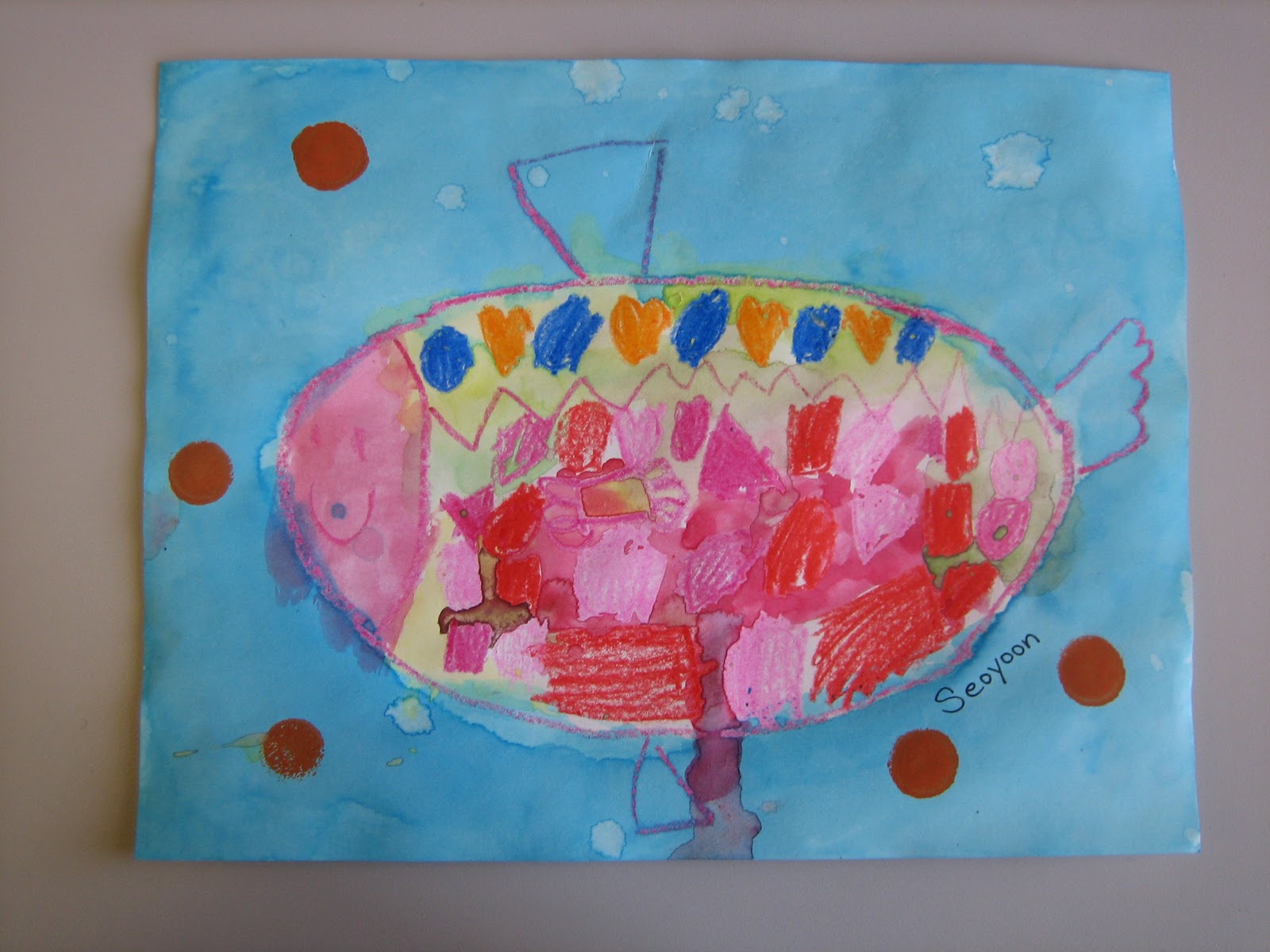
Kindergarten - Pattern Fish

This is a project I would have done with Kindergarten students anyway, but figured it would make for lovely artworks for the Art to Remember fundraiser.  Students already had previous experience with lines, shapes, and patterns so this lesson was perfect in that it encompassed all three.  I begin all my lessons with an anecdote that relates to the topic, in this case I was browsing my local library and stumbled upon a book about fish.  Did you know that a group of fish is called a school?  That reminded me of all of us, because we're a group of people who like to learn new things...and so on and so forth lol.  We discussed all the geometric shapes we might use to draw a fish and for what parts (circle or oval for the body, triangles for the fins, circles for the eyes, etc.).  Because the paper used was so small (about 8 1/2 by 11) I pre-drew fairly large ovals in the center which ensured that every student would have a large fish (no tiny guppies!).  We used regular crayons to fill in our fish with patterns since oil pastels are a bit too bulky and tiny hands would have trouble making their intricate patterns.  A wash of blue watercolor for the ocean was added.  On the second day we added color to our fish (using only light colors to have our fish stand out against the blue).  I stumbled upon paint markers which I thought the kids would enjoy.  I demonstrated how to use the markers to add "bubbles" for our fish; the kids really seemed to enjoy that.  I think their work came out great!


Friday, November 12, 2010

Wild Things!

Here are some photos of the Wild Things project from a few week ago.  I've seen this project done a variety of ways so I can't really attribute it to one specific source...but what I liked about it was that it reviewed vocabulary (geometric shapes, lines), allowed students to practice/reinforce their motor skills (drawing, cutting, gluing), and incorporated a literacy component (read-aloud).  I'm looking forward to writing more art lessons based on childrens' books!
Day 1 - Read Wild Things book, discuss animal characteristics and geometric shapes that might be used to draw creatures.  Review lines that could be used to fill in creatures' bodies.
Day 2 - Review proper watercolor usage and paint creatures.
Day 3 - Carefully cut out creatures.  Demonstrate using Elmer's glue properly (dot, dot, dot method) and apply to the back of cut-out.  Use both hands to adhere cut-out to construction paper background.

Tuesday, November 9, 2010

Art Games

Here are some art games that I think would make a great incentive.  For example, if students behave and are productive after a few projects they may be rewarded with one day of art-centric activities (such as these games).

Block Buddies
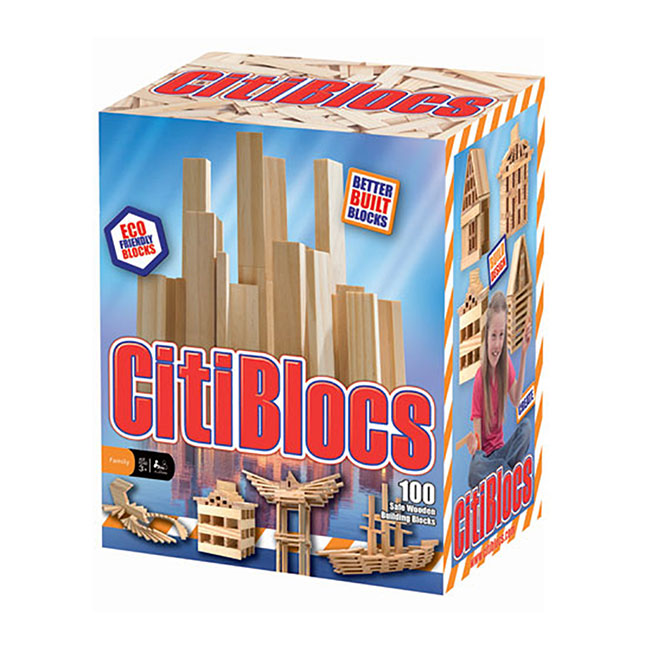
CitiBlocs
Tangram Puzzles
Connectagons Happy Faces