Wow! I've been gone for quite some time so there's much to update. Second Graders are just about completing a big printmaking unit that coincides with their Social Studies unit about urban, suburban, and rural neighborhoods. We spent the first day of the lesson discussing all the things that make our community urban and the various things we see while traveling in it (the stores, cars, people, tall buildings, and so on). We learned that geometric shapes (shapes found in Math) and organic shapes (shapes found in Nature) can be used in creating a collagraph plate of a part of our neighborhood using manila folders. This took about two class periods. Afterward I introduced the tools used in creating a print (brayer, printmaking ink, and of course collagraph plate). We went over the steps in creating a print, and two by two I had students come over to the "inking station" and ink their plates while the other students worked on an activity sheet. The fourth day students used pieces of scrap paper to create a symmetrical boarder around their print (we'll need a fifth day for all students to complete their prints, it's tough only having two brayers available!).
Monday, March 21, 2011
Friday, January 28, 2011
Matisse Inspired Goldfish Bowl
These were created by some very talented Second Graders. I was first introduced to this lesson by a lovely K-6 Art Teacher whose class I took over as a long term substitute last year. Her version involved more coloring with crayons and painting with watercolors...however she did have the students include a window in the background and corners to indicate a room. While blog surfing I realized that this lesson is quite popular and can be done in a variety of ways so I decided to attempt it myself with the students. Although it is a very involved lesson with multiple steps (about 4-5 sessions) the learning is worth it.
Kindergarten Update and Pendants
Snowflakes that were begun the day before Winter Recess...simple oil pastel resist.
Textured pendants - one day for exploration and another day for creation of final piece.
Tuesday, January 18, 2011
Textured Mittens
First Graders just completed these lovely textured mittens. We began by reading The Mitten by Jan Brett, which served as a great inspiration for the students. They then were introduced to the word texture (the way an object feels) and began cutting up strips of various fabric. On the second day we discussed the word symmetry and used the analogy of a butterfly as an example from nature. We arranged our fabric strips from the week prior in a way that was symmetrical, thus creating a pair of matching mittens. The third day students cut up glitter paper (made by brushing glitter glue on regular construction paper) and arranged their pieces to form a border surrounding their mittens...similar to the the borders surrounding Brett's lovely illustrations. This lesson was inspired by the lesson found on the color, collage, and much more blog (http://colorandcollage.blogspot.com/), one of my favs!
Sunday, January 9, 2011
Inspiration for Future Art Lessons
I'm dedicating this post to art lesson ideas gathered from some wonderful art teacher blogs from around the web! I plan on creating lessons inspired by these posts and appropriating them to meet the needs of my students. Thank you to all the art educators who constantly inspire me to try new and exciting things!
Kindergarten
http://modernartsmock.blogspot.com/2011/01/1st-grade-picasso-faces.html
http://linesdotsanddoodles.blogspot.com/2010/12/ten-black-dots-kindergarten.html
http://www.eduplace.com/rdg/hme/k_5/shapebook/toc.html
http://kids-finelines.blogspot.com/2011/05/city-shapes-and-sounds.html
http://linesdotsanddoodles.blogspot.com/2010/12/ten-black-dots-kindergarten.html
http://www.eduplace.com/rdg/hme/k_5/shapebook/toc.html
http://kids-finelines.blogspot.com/2011/05/city-shapes-and-sounds.html
http://aheartists.blogspot.com/2009/09/first-grade-cityscapes.html
1st Grade
http://www.flickr.com/groups/1005798@N23/pool/page5/
http://sgpart.blogspot.com/2010/08/lots-of-lines.html
http://josettebrouwer.edublogs.org/2010/09/16/lines-and-more-lines/
http://artlessonsforkids.wordpress.com/2008/11/30/lines-all-around/
http://kids-finelines.blogspot.com/2011/03/still-life-collage.html
http://mrspicassosartroom.blogspot.com/2010/03/mr-mrs-gadget.html
http://artolazzi.blogspot.com/2011/03/kandinsky-paintings.html
http://www.artismessy.org/?p=495
http://artlessonsforkids.wordpress.com/2008/11/30/lines-all-around/
http://kids-finelines.blogspot.com/2011/03/still-life-collage.html
http://mrspicassosartroom.blogspot.com/2010/03/mr-mrs-gadget.html
http://artolazzi.blogspot.com/2011/03/kandinsky-paintings.html
http://www.artismessy.org/?p=495
http://mrspicassosartroom.blogspot.com/2010/09/name-projects.html
http://ms-artteacher.blogspot.com/2010/09/joan-miro-animals.html
http://snippetygibbet.blogspot.com/2011/02/first-grade-architecture.html
2nd Grade
http://ms-artteacher.blogspot.com/2010/09/joan-miro-animals.html
http://snippetygibbet.blogspot.com/2011/02/first-grade-architecture.html
2nd Grade
http://dalimoustache.blogspot.com/2010/01/collagraphs.html
http://pantherspalette.blogspot.com/2011/02/2nd-grade-starry-night-paintings.html
http://davinciswings.blogspot.com/2010/02/2nd-grade-printmaking.html3rd Grade
http://artwithrmotta.blogspot.com/2010/12/3rd-grade-torn-paper-landscapes.html
http://dolvinartknight.blogspot.com/2011/03/picassos-guitar-cubism-for-2nd-graders.html
http://dolvinartknight.blogspot.com/2011/01/matisse-inspired-studio-collages.html
http://vividlayers.blogspot.com/2011/05/contour-shoes-3rd-grade.html
http://dolvinartknight.blogspot.com/2011/03/picassos-guitar-cubism-for-2nd-graders.html
http://dolvinartknight.blogspot.com/2011/01/matisse-inspired-studio-collages.html
http://vividlayers.blogspot.com/2011/05/contour-shoes-3rd-grade.html
Friday, December 17, 2010
Fundraiser Projects - Pre K
Pre K - Flowers
medium bristle brushes
paper plates
In order to do this project in a one hour period, I decided to prepare the paper beforehand using squares of bleeding tissue paper. Normally I would distribute a variety of colored construction paper for students to paint on but because this was for a fundraiser and the paper was non-negotiable I opted do to this instead. I chose a simple subject (flowers) and broke it down into simple shapes for the center of the flowers and lines for the petals. After spending more time with Pre K students I've decided that working in groups of 4-5 at a time would ensure that every student get an adequate amount of one-on-one time while working on their paintings. It's quite difficult to manage 18 Pre K students on a painting project all at once! Of course this means that projects would last longer and span a period of a few classes but I'd be willing to try if it means a higher success rate.
Suggested Materials
artificial flowers (daisies, roses, sunflowers) or photographs of flowers
sponges cut out into circle and petal shapes (for a stamping/printmaking approach)Suggested Materials
artificial flowers (daisies, roses, sunflowers) or photographs of flowers
medium bristle brushes
paper plates
Fundraiser Projects - First Grade
First Grade - Still Life Flowers
Ideally this project would be broken down into two lessons (1 day for oil pastel/drawing from observation and 1 day for watercolor washes), but because of time constraints I had to condense the project into one day. To do this I had to do a directed drawing lesson where I broke down the drawing into steps (find center of paper, use geometric shapes to draw a simple vase, emphasize originality). I gave examples of flowers that could be drawn, such as daisies, roses, and tulips (students had the option of drawing other types of flowers as well). To complete the project, we used two halves of bleeding tissue paper (different colors) and arranged them on the top and bottom of the drawing to give the allusion of the vase sitting on top of a table.
I'm pleased with the results considering how limited in time we were, but if I were to do this project again in its condensed version I'd have created 3 drawings of each step (1. drawing of vase, 2. drawing of flowers in vase, and 3. drawing with final watercolor step). This would have given the students a better idea of where the project was going. Finally we would discuss oil pastel resist...which would have been very evident following the bleeding tissue paper.
Friday, December 3, 2010
Matisse Cut-Outs
First Grade students learned about the French artist Henri Matisse. We focused on his later works, specifically his cut-outs. Students took note of the geometric shapes found in the background of his collages, and the organic shapes found in the foreground. Typically I would approach this lesson by having students create a variety of painted paper, cut them out into squares and rectangles, adhere them onto another larger sheet of paper, and use black & white construction paper for the organic shapes. However, this would require twice the amount of paper and had the possibility of requiring an additional fourth day to complete. Painting geometric shapes onto one large sheet of paper required less materials and days (3 to be exact, 2 if I used 9 x 12 paper). This lesson was inspired by the There's a Dragon in my Art Room blog...such great lessons!
Wednesday, November 24, 2010
Fundraiser Projects
Kindergarten - Pattern Fish
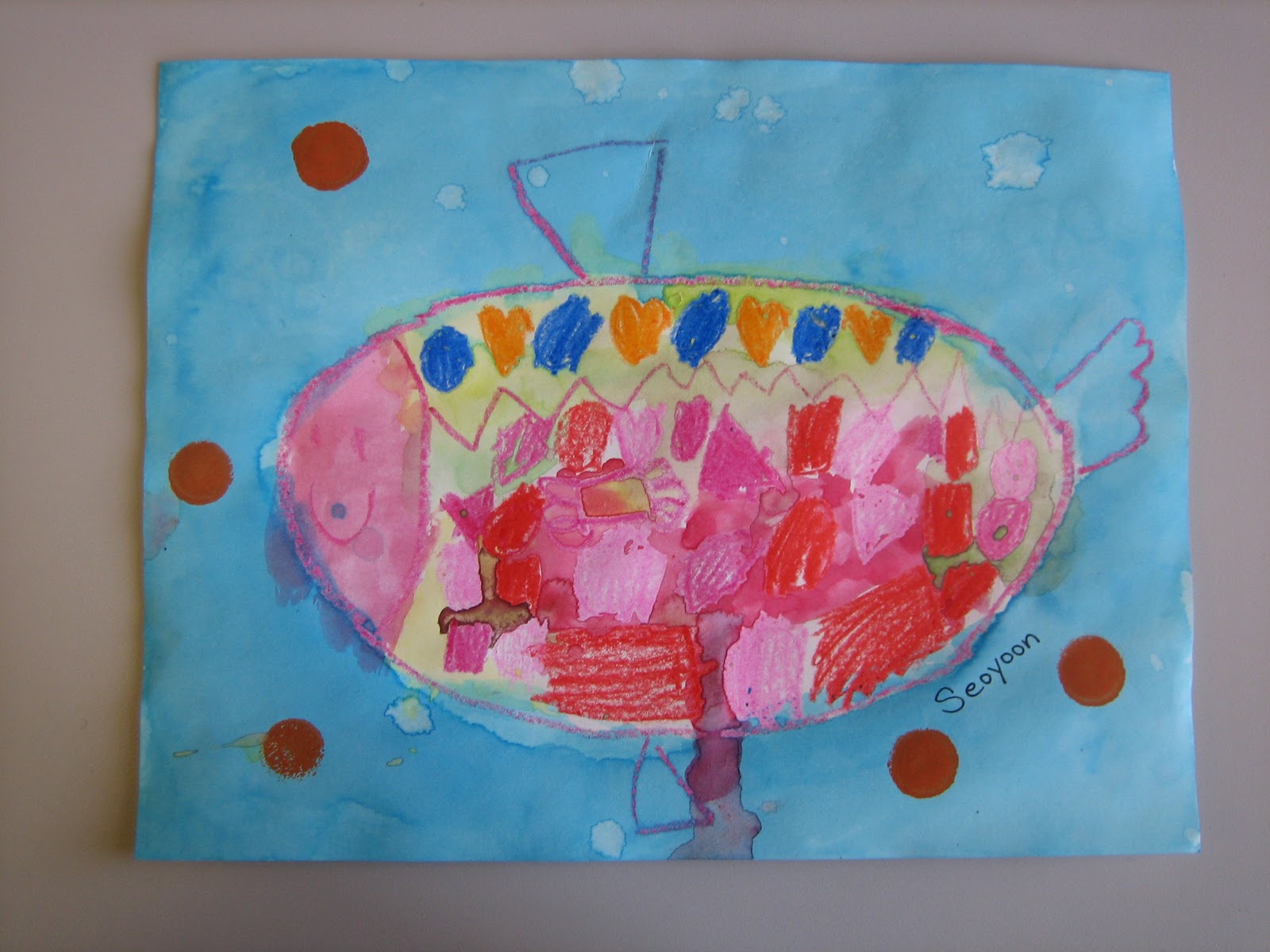
This is a project I would have done with Kindergarten students anyway, but figured it would make for lovely artworks for the Art to Remember fundraiser. Students already had previous experience with lines, shapes, and patterns so this lesson was perfect in that it encompassed all three. I begin all my lessons with an anecdote that relates to the topic, in this case I was browsing my local library and stumbled upon a book about fish. Did you know that a group of fish is called a school? That reminded me of all of us, because we're a group of people who like to learn new things...and so on and so forth lol. We discussed all the geometric shapes we might use to draw a fish and for what parts (circle or oval for the body, triangles for the fins, circles for the eyes, etc.). Because the paper used was so small (about 8 1/2 by 11) I pre-drew fairly large ovals in the center which ensured that every student would have a large fish (no tiny guppies!). We used regular crayons to fill in our fish with patterns since oil pastels are a bit too bulky and tiny hands would have trouble making their intricate patterns. A wash of blue watercolor for the ocean was added. On the second day we added color to our fish (using only light colors to have our fish stand out against the blue). I stumbled upon paint markers which I thought the kids would enjoy. I demonstrated how to use the markers to add "bubbles" for our fish; the kids really seemed to enjoy that. I think their work came out great!
Friday, November 12, 2010
Wild Things!
Here are some photos of the Wild Things project from a few week ago. I've seen this project done a variety of ways so I can't really attribute it to one specific source...but what I liked about it was that it reviewed vocabulary (geometric shapes, lines), allowed students to practice/reinforce their motor skills (drawing, cutting, gluing), and incorporated a literacy component (read-aloud). I'm looking forward to writing more art lessons based on childrens' books!
Day 1 - Read Wild Things book, discuss animal characteristics and geometric shapes that might be used to draw creatures. Review lines that could be used to fill in creatures' bodies.
Day 2 - Review proper watercolor usage and paint creatures.
Day 3 - Carefully cut out creatures. Demonstrate using Elmer's glue properly (dot, dot, dot method) and apply to the back of cut-out. Use both hands to adhere cut-out to construction paper background.
Tuesday, November 9, 2010
Art Games
Here are some art games that I think would make a great incentive. For example, if students behave and are productive after a few projects they may be rewarded with one day of art-centric activities (such as these games).
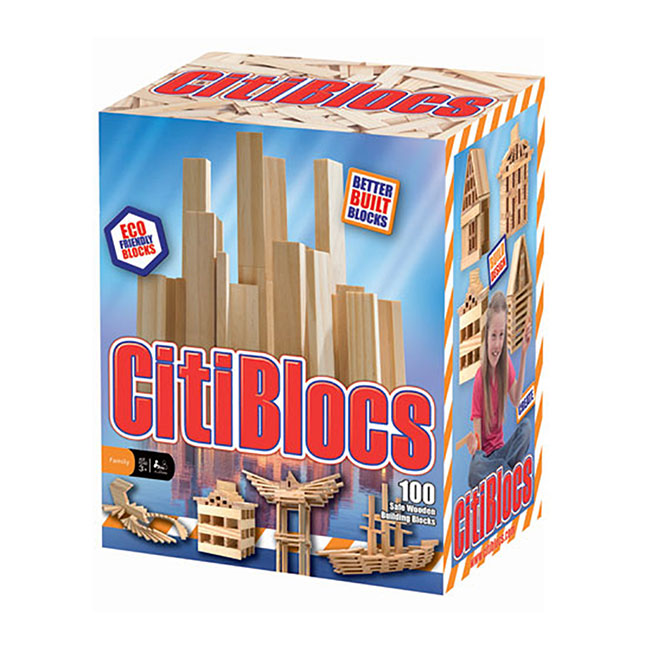
| Block Buddies |
| Tangram Puzzles |
| Connectagons Happy Faces |
Friday, November 5, 2010
Update and Photos
Wow there's so much to update!
Kindergarten - After working on textures (leaf rubbings) and patterns (AB pattern focusing on shapes and colors), we finally completed our color mixing sequence. Each week for the past three weeks we've been focusing on two primary colors and mixing them to create a secondary color. The students bring in their prior knowledge of objects of a particular color in the lesson, that way they become more invested in the learning. I never tell the students what color they are going to create in the beginning of the lesson; the discovery is part of the learning (and children will retain that knowledge better when the experience is more meaningful, as opposed to me just telling them). Next we are going to work on a fundraiser project that I would have done with the students regardless. Since we explored shapes, patterns, and a bit of watercolor already we are going to create fish using all three experiences. I need to search the library for a few books on tropical fish photography for inspiration.
First Grade - We completed our Wild Things! I'm happy with how they turned out and I learned a lot about working with students with a wide range of abilities. In the future I must make it a note to keep their creatures simple by focusing on geometric shapes (and less crazy appendages). Some students' drawings were quite involved and had an abundance of arms and tails which made it harder for their little hands to cut around. This just reinforced my belief that we could all use more and more cutting practice! For our next lesson I would like to introduce Henri Matisse as the next Artist of the Month. We will be talking about geometric versus positive shapes, creating painted paper, and drawing with scissors! Ideally this lesson with take place over the course of three days.
Second Grade - We completed our Autumn Leaves drawing/painting lesson and many of them are on display in the hallway. Next we are going to focus on a fundraiser project based on cat and dog portraits using oil pastels and watercolor.
| Finished Autumn Leaves Bulletin Board |
| I love the contrast between the blue and red wall. Really makes the artwork stand out! |
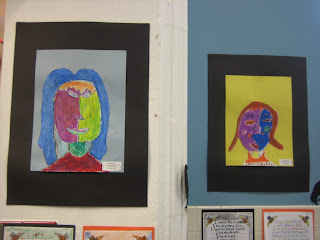
| A small display of Picasso Portraits at the end of the 3rd floor hallway. |
Friday, October 22, 2010
Second Grade Autumn Leaves (In Progress)
This is what the students have been working on so far:
Kindergarten - After exploring lines and shapes they were introduced to texture by creating leaf rubbings in various Autumn shades. It was a bit difficult for students to create a clear rubbing since they had to use both hands to steady the paper and to use the oil pastel, however they enjoyed seeing their leaves magically appear on the top (for a different spin on the texture concept I might use hand-made texture plates or create a collage using scrap fabrics and materials). Now they are exploring color! This will be a three class sequence where students will learn that blue+yellow=green, blue+red=purple, and red+yellow=orange. We began by first discussing all the things that are naturally blue and yellow (the sky, water, bluebirds, blueberries, the sun, bananas, sunflowers, lemons, and so on). One row of students began with the blue paint and the other row of students began with the yellow paint. After 10-15 minutes we switched colors and before you know it they realized that by mixing blue and yellow you make green! At the end of class we discussed our discovery and went over a few things that are naturally green (green beans!!!).
First Grade - We began our Wild Things project by reading the Maurice Sendak book and going over the different animal features each Wild Thing had (like horns, scales, feathers, etc.). We talked about what shapes we might use to draw the head, body, arms, and legs of our creatures and the various lines we might use to fill in their bodies. Next week the students will use watercolors to paint in their creatures. We'll talk about the difference between watercolors and regular paint, how to dip the brush in water first and then in the paint, how we can tell if we have enough paint on our brush, and so on. It's really quite a process when you break it down!
Second Grade - The students are almost done with their Autumn Leaves paintings. I introduced them to the concept of warm and cool colors (yellow, orange, and red for leaves/blue, green, and purple for the background). We looked through a few photos from the Ken Robbins book Autumn Leaves and realized that leaves aren't just one solid color but go through a gradual process of changing from one color to another. Afterward, we discussed what the term "background" might mean (the space around the subject) and I demonstrated using a brush and paint to first carefully and slowly outline a leaf and then paint the space surrounding it. I think this might be a good technique for Second graders since they are still mastering material and tool use. Once they are Third graders they could be introduced to the wet-on-wet technique (I actually began introducing this technique to one class but opted not to for the second class, since I was afraid the paper they were painting on might not be able to support that much water).
| Second Grade Autumn Leaves |
| These were all drawn from observation. |
Thursday, October 14, 2010
Some Photos
I've finally managed to capture a few photos of some of the artwork...
![]() |
| Kindergarten Line and Shape Explorations on display in the stairwell. |
| Beautiful variety of lines! |
![]() |
| Such cheerful colors! |
![]() |
| They look so nice hung on a red wall. |
![]() |
| First Grade Picasso Harlequins |
![]() |
| Second Grade Picasso Inspired Self-Portraits |
![]() |
| The students worked really hard on these and it shows! |
Monday, October 11, 2010
Dream Book List
For the past three weeks I have found myself browsing the children's books section of my local library(s). I love combining literature with my art lessons and find myself doing so more and more lately since I've been working exclusively with early childhood grades. It's a wonderful feeling to have a group of kindergarten students eagerly raise their hands to guess what might happen next in a story and laugh hysterically when something silly happens. This let's me know how interested they are in the book and it's a good indicator of whether or not my art lesson will resonate with them. Often times I'll choose a book to either spark interest in a lesson or support it. The following are a list of books I would love to use in future art lessons...
| A great book about being individual and unique. However, I would only use it knowing that the majority of my students actually live in homes as opposed to apartment buildings...after all, not everyone is lucky enough to live in a house (including me!). This could make a great drawing/collage lesson for Kindergarten students ("What might your dream house look like?"). |
| This book describes how animals use their different body parts for various jobs. I think this would resonate well with Second Grade students...we could create painted paper much like the paper featured in the book and use the sheets to make animal collages. |
| A great book for a Spring art lesson focusing on birds. The lesson could focus on various birds you might see in the Spring time, breaking up the parts of their body in various shapes, and using tempera to paint them in. |
| This book introduces the artists Picasso and Matisse and retells their relationship through humorous illustrations. If the next artist we focus on is Henri Matisse then I'll be sure to read the students this book at the conclusion of the project (since we've already focused on Picasso). |
Subscribe to:
Posts (Atom)